

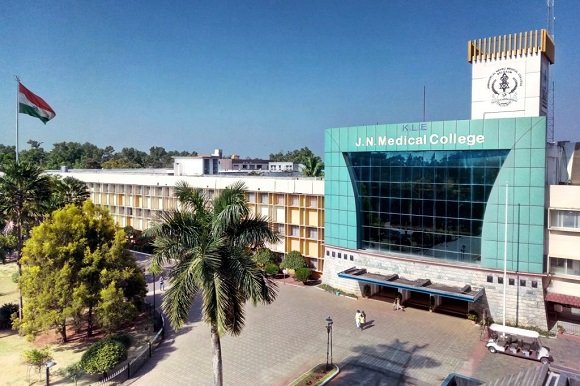
The Definitive Guide to Direct MBBS Admission in KLE Medical College (JNMC), Belgaum: Fees, Seat Matrix, and Counselling Process
Securing a medical seat in India is one of the most highly competitive academic pursuits in the world. For medical aspirants and parents navigating the complex landscape of NEET cutoffs, state counseling, and deemed university admissions, Jawaharlal Nehru Medical College (JNMC), Belgaum stands out as a premier destination.
Affiliated with the KLE Academy of Higher Education and Research (KAHER) — a Deemed-to-be-University — JNMC Belagavi is renowned for its world-class infrastructure, massive clinical exposure, and decades of academic excellence. However, understanding the exact pathway to admission, particularly through the Management and NRI quotas, requires deep insight into the Medical Counselling Committee (MCC) processes, exact fee structures, and the shifting dynamics of the seat matrix.
This comprehensive guide breaks down everything you need to know about getting direct MBBS admission into KLE Medical College, Belgaum, stripping away the myths and providing you with hard, actionable facts.
1. Overview of Jawaharlal Nehru Medical College (JNMC), Belgaum
Established in 1963, JNMC is one of the oldest and most respected private medical institutions in Karnataka. Recognized by the National Medical Commission (NMC) and accredited with an ‘A+’ grade by NAAC, the college operates under the umbrella of the KLE Society, which runs over 270 educational institutions.
The college is attached to the Prabhakar Kore Hospital and Medical Research Centre, a massive 2,400-bed teaching hospital. For an MBBS student, hospital bed capacity is the most critical metric. A 2,400-bed facility guarantees that students will see a vast and diverse volume of clinical cases, from routine tropical diseases to complex super-specialty surgeries, making the clinical rotations highly enriching.
Quick Facts at a Glance
-
Establishment Year: 1963
-
University Affiliation: KLE Academy of Higher Education & Research (KAHER), Deemed University
-
NMC Approval: Fully Recognized
-
Total MBBS Intake: 200 Seats
-
Attached Hospital Bed Capacity: 2,400+ Beds
-
Counseling Authority: Medical Counselling Committee (MCC), DGHS, New Delhi
2. JNMC Belgaum MBBS Seat Matrix Breakdown
Understanding the seat matrix is the first step in formulating your admission strategy. Because KAHER is a Deemed University, 100% of its seats are filled through the centralized counseling conducted by the MCC. State counseling bodies (like KEA in Karnataka) do not have jurisdiction over the primary Management and NRI seats here.
The total annual intake for the MBBS program at JNMC Belgaum is 200 seats. These are strictly divided into two distinct categories:
A. Management / General Quota Seats (85%)
-
Total Seats: 170
-
Eligibility: Open to all NEET-UG qualified candidates across India, regardless of their domicile state.
-
Admission Authority: MCC (All India Counseling).
B. Non-Resident Indian (NRI) Quota Seats (15%)
-
Total Seats: 30
-
Eligibility: Reserved for NRIs, Overseas Citizens of India (OCI), Persons of Indian Origin (PIO), and candidates sponsored by strict blood relatives who are NRIs.
-
Admission Authority: MCC (All India Counseling).
Key Insight: Unlike state-run or strictly private universities affiliated with state bodies, Deemed Universities do not have a massive subsidized “Government Quota.” A very small handful of seats may occasionally be subjected to local state agreements, but for the general national applicant, you are competing for the 170 Management seats or the 30 NRI seats.
3. Deep Dive: MBBS Fee Structure at KLE Medical College
One of the most critical aspects of planning for a Deemed University is financial readiness. The fee structure at JNMC is premium, reflecting its top-tier infrastructure and deemed status. Fees are charged for 4.5 years of the 5.5-year course (the final year is a paid internship).
The Management Quota Fee Structure
For Indian students securing a seat under the 170 General/Management quota seats, the fee structure is as follows:
-
Year 1: ₹ 19,15,000
-
Year 2: ₹ 19,15,000
-
Year 3: ₹ 19,15,000
-
Year 4: ₹ 19,15,000
-
Year 5 (Final 6 Months): ₹ 9,57,500 (approximate, billed as half of the annual tuition)
-
One-Time Admission Fee: ₹ 5,000
Total Estimated Tuition Cost (Management): Approximately ₹ 86,17,500 for the entire 4.5-year academic duration.
The NRI Quota Fee Structure
For students taking admission against the 30 NRI seats, fees must be paid in US Dollars (USD) from an NRI bank account.
-
Year 1: $ 45,500
-
Year 2: $ 44,000
-
Year 3: $ 44,000
-
Year 4: $ 44,000
-
Year 5 (Final 6 Months): $ 24,000
-
One-Time Miscellaneous Fee: $ 1,500
Total Estimated Tuition Cost (NRI): Approximately $ 201,500.
Hostel and Mess Fees
Staying on campus is highly recommended for medical students due to the rigorous academic schedule and late-night clinical postings.
-
Hostel & Mess (Annual): ₹ 1,36,000 per year (for standard accommodation).
-
Refundable Caution Deposit: Ranges from ₹ 13,000 to ₹ 30,000 depending on the specific hostel block (Chanakya Boys Hostel, Akkamahadevi Ladies Hostel, or dedicated NRI hostels).
Financial Insight for Parents: When planning for admission, do not just calculate the first year’s tuition. Deemed universities strictly enforce fee schedules. Furthermore, at the time of admission, candidates are often required to provide a bank guarantee or post-dated cheques for the subsequent years’ tuition fees to secure the seat.
4. The Reality of “Direct Admission” and Management Quota
A common misconception in Indian medical admissions is the term “Direct Admission.” Many parents and candidates assume this means paying a hidden capitation fee or donation directly to the college administration to bypass the merit list.
This is entirely false.
Since the intervention of the Supreme Court and the National Medical Commission, there is no backdoor entry into any recognized medical college in India. All admissions, including the Management Quota and NRI Quota, must strictly pass through the Medical Counselling Committee (MCC).
What Does “Direct Admission” Actually Mean Today?
In modern terms, “Direct Admission” refers to strategically securing a seat in the Management or NRI quota by navigating the later rounds of MCC counseling—specifically the Mop-Up Round and the Stray Vacancy Round.
Here is how the dynamic works:
-
High Fees Equal Lower Cutoffs: Because the fees at JNMC Belgaum are approximately ₹19.15 Lakhs per year, many top-ranking students (who secure government seats at ₹1 Lakh/year) will drop their allotted Deemed seats in Rounds 1 and 2.
-
Seat Vacancies: As students upgrade to government colleges, seats at JNMC open up in the Mop-Up and Stray Vacancy rounds.
-
Strategic Bidding: Candidates with lower NEET scores (but strong financial backing) who have registered for Deemed University counseling can secure these exact seats legally, directly through the MCC portal based on the remaining applicant merit list.
Therefore, “Direct Admission” is simply strategic counseling management, knowing when to hold your security deposit, when to float your choices, and how to target the Stray Vacancy round.
5. NRI Quota Admissions: Rules, Eligibility, and Sponsorship
The 30 NRI seats at JNMC Belgaum offer a lifeline to students who have qualified NEET but have lower scores. The cutoff for NRI seats is substantially lower than the Management quota, often dipping close to the NEET qualifying percentile.
However, the documentation required to prove NRI status is heavily scrutinized by the MCC. You cannot simply claim to be an NRI; you must provide legal proof.
Who is Eligible for the NRI Quota?
-
Actual NRIs/OCIs/PIOs: The candidate themselves holds a foreign passport or NRI status.
-
Sponsored Candidates: The candidate is an Indian citizen, but their education is being completely sponsored by a strict blood relative who is an NRI.
Who Qualifies as an NRI Sponsor?
The Supreme Court of India has strictly defined who can be a sponsor to prevent fraud. The sponsor must be a first-degree blood relative:
-
Father or Mother
-
Real Brother or Sister
-
Paternal or Maternal Uncle (Chacha/Mama)
-
Paternal or Maternal Aunt (Bua/Masi)
-
Grandparents
Mandatory Documents for NRI Admission
To convert your category to NRI during MCC counseling, you must email a specific set of documents to the DGHS before choice filling begins. These include:
-
Sponsorship Affidavit: A notarized document from the sponsor stating they will bear the entire cost of the 4.5-year education.
-
Embassy Certificate: A certificate from the Indian Embassy in the sponsor’s residing country validating their NRI status.
-
Passport and Visa: Copies of the sponsor’s valid passport and residence/work visa.
-
Relationship Proof: Legal documents (birth certificates, family tree certificates issued by a Tahsildar) proving the exact biological relationship between the candidate and the sponsor.
-
NEET Scorecard & Admit Card.
Expert Insight: Do not wait until counseling begins to gather these documents. Embassy certificates can take weeks to process. Have your NRI dossier ready by the time NEET results are declared.
6. Eligibility Criteria for MBBS at JNMC Belgaum
Before diving into the counseling process, ensure you meet the strict baseline criteria set by the NMC:
-
Academic Requirements: The candidate must have passed the 10+2 (or equivalent) examination with Physics, Chemistry, Biology/Biotechnology, and English as core subjects.
-
Minimum Marks: * General Category: 50% aggregate in Physics, Chemistry, and Biology.
-
OBC/SC/ST: 40% aggregate in PCB.
-
PwD: 45% aggregate in PCB.
-
-
Age Limit: The candidate must be at least 17 years old on or before December 31st of the admission year. There is currently no upper age limit for NEET-UG.
-
NEET Qualification: The candidate MUST have qualified the NEET-UG examination by crossing the minimum percentile cutoff set for that specific academic year (usually the 50th percentile for General and 40th percentile for reserved categories). No NEET qualification = No Admission.
7. Step-by-Step MCC Counseling Process for JNMC Belgaum
Navigating the Medical Counselling Committee (MCC) portal can be daunting. Because JNMC is a Deemed University, you must select the specific “Deemed University” option during registration.
Here is the exact step-by-step process:
Step 1: MCC Registration and Security Deposit
-
Go to mcc.nic.in after the official notification is released.
-
Register using your NEET roll number and application details.
-
Crucial Step: When asked for the counseling type, you must select Deemed Universities.
-
The Fees: You will be required to pay a non-refundable registration fee (approx. ₹5,000) AND a refundable security deposit of ₹ 2,00,000.
-
Note: If you do not pay the ₹2 Lakh deposit, you will not be allowed to fill choices for JNMC Belgaum or any other deemed medical college.
Step 2: Choice Filling and Locking
-
Once registered, you will access the choice-filling portal.
-
Search for “Jawaharlal Nehru Medical College, Belgaum” or “KLE Medical College”.
-
Prioritize it at the top of your list.
-
Lock your choices before the deadline. If you forget to lock, the system will auto-lock your last saved preferences.
Step 3: Round 1 Allotment & Reporting
-
The MCC releases the Round 1 result. If allotted JNMC Belgaum, download your allotment letter.
-
You must physically report to the JNMC campus in Belgaum within the stipulated timeframe.
-
Carry all original documents (10th/12th mark sheets, TC, Migration, NEET scorecard, ID proof).
-
Pay the first year’s tuition fee (₹19,15,000) via Demand Draft (DD) or RTGS as instructed by the college to secure the seat.
-
Free Exit: If you are allotted a seat in Round 1 but decide not to join, you can take a “Free Exit” without losing your ₹2 Lakh deposit.
Step 4: Round 2 and Upgradation
-
If you weren’t allotted a seat in Round 1, or if you joined JNMC but want to try for a different college, you can participate in Round 2.
-
Be warned: There is no Free Exit in Round 2. If you are allotted a seat in Round 2 and do not join, your ₹2,00,000 security deposit will be forfeited.
Step 5: Mop-Up Round (Round 3)
-
Seats that remain vacant after Round 2 are pushed to the Mop-Up round.
-
Fresh registrations are allowed here. This is where candidates targeting “Management Quota” with lower scores should be highly active, as cutoffs tend to fluctuate unpredictably.
Step 6: Stray Vacancy Round
-
The final frontier. Any seats left over after the Mop-Up round go into the Stray Vacancy round.
-
Historically, this round was conducted at the college level, but recent NMC guidelines mandate that the Stray Vacancy round is also conducted online by the MCC to ensure absolute transparency.
-
You cannot fresh register for the Stray Vacancy round; you must have been registered in the earlier rounds but remain unallotted.
8. NEET Cutoff Analysis for JNMC Belgaum
To build a realistic strategy, you must look at historical cutoff trends. Because JNMC Belgaum is highly sought after, its cutoffs are generally higher than lower-tier deemed universities, despite the high fees.
(Note: Cutoffs vary every year based on exam difficulty and the overall performance of the candidate pool. The following are indicative trends based on recent years.)
Management Quota Cutoff Trends
-
Round 1: Usually closes around a NEET score of 610 to 620 (All India Rank ~50,000 to 65,000). Many high-scorers keep Deemed seats as backups in Round 1.
-
Round 2: Often sees a slight drop, closing around 590 to 600.
-
Mop-Up Round: This is where the true picture emerges. Depending on the year, the mop-up cutoff can stabilize around 570 to 585 (All India Rank ~1.1 Lakh to 1.3 Lakh).
-
Stray Vacancy: If seats remain, the cutoff can occasionally dip to the 550s, but relying entirely on the Stray round is a massive gamble.
NRI Quota Cutoff Trends
The NRI quota paints a completely different picture. Because the financial barrier is extremely high (over ₹1.6 Crores total), the competition is significantly lower.
-
NRI cutoffs at JNMC typically range from 150 to 350 marks, depending heavily on the applicant pool that year. Essentially, if you have valid NRI sponsorship and have legally qualified NEET, securing an NRI seat is highly probable.
9. Why Choose Jawaharlal Nehru Medical College, Belagavi?
If you are committing upwards of ₹86 Lakhs for an MBBS degree, you must ensure the Return on Investment (ROI) in terms of education quality is worth it. Here is why JNMC is a top-tier choice:
A. Unmatched Clinical Material
Medical science is not learned in a classroom; it is learned in the wards. With the 2,400-bed Prabhakar Kore Hospital, students witness incredible patient footfall. From rural trauma cases to advanced robotic surgeries, the sheer volume of “clinical material” prepares students for real-world medical practice better than almost any other private college.
B. State-of-the-Art Infrastructure
KAHER heavily reinvests in its facilities. The campus boasts an advanced Clinical Skills Lab where students can practice procedures on high-fidelity mannequins before touching actual patients. The central library is vast, housing thousands of international medical journals.
C. Strong Postgraduate Presence
JNMC offers a wide array of MD, MS, and Super-Specialty (DM/MCh) programs. For an MBBS undergraduate, being surrounded by residents and super-specialists creates a rigorous academic environment. Furthermore, having an MBBS degree from a reputed institution like JNMC carries weight when applying for PG programs later.
D. Global Alumni Network
KLE alumni are spread across the globe, with strong representations in the US (USMLE clears), the UK (PLAB clears), and the Middle East. The alumni network provides a strong support system for students looking to pursue residency abroad.
10. Conclusion & Final Verdict
Securing Direct MBBS Admission in KLE Medical College (JNMC), Belgaum, is a test of both academic merit and strategic counseling execution. It is not about paying a hidden donation; it is about legally navigating the MCC Management and NRI quotas.
For candidates scoring between 570 and 610 who may miss out on government seats, JNMC offers a brilliant alternative—provided the family is financially prepared for the ₹19.15 Lakh annual fee. For students with lower scores but international ties, the NRI quota provides a legitimate, transparent pathway to one of India’s best medical schools.
The key to success is preparation. Have your finances in order, keep your NRI documents authenticated months in advance, pay your ₹2 Lakh MCC security deposit on time, and track the shifting cutoffs from Round 1 to the Stray Vacancy round with hawk-like precision.
Frequently Asked Questions (FAQs)
Q: Can I get direct admission in JNMC Belgaum without NEET?
A: Absolutely not. Qualifying NEET is a mandatory legal requirement for studying MBBS anywhere in India, including the Management and NRI quotas at JNMC Belgaum.
Q: Is JNMC Belgaum a government or private college?
A: It is a constituent college of the KLE Academy of Higher Education and Research (KAHER), which is a Private Deemed-to-be-University.
Q: Do I need to apply through the Karnataka Examination Authority (KEA) for JNMC?
A: No. For the 170 Management seats and 30 NRI seats, you must apply exclusively through the Medical Counselling Committee (MCC) under the Directorate General of Health Services (DGHS).
Q: What is the stipend for the compulsory rotatory internship at JNMC?
A: Deemed universities are known to pay lower stipends compared to government colleges. However, the stipend rules are frequently updated by the NMC. It is advisable to check the exact monthly stipend figure with the college administration during admission.
Q: Can a non-Karnataka student apply for the Management Quota at JNMC?
A: Yes. Since it is a Deemed University, it has an “All India Character.” A student from Delhi, Maharashtra, or Tamil Nadu has the exact same right to the Management seats as a student from Karnataka. Domicile does not matter for MCC Deemed counseling.