

Direct PG Medical Admission 2026: The Definitive Guide to Fees, Seat Matrix, and Branch ROI
Securing a postgraduate medical seat (MD/MS) in India is one of the most intensely competitive milestones in a physician’s career. Each year, over 2 lakh MBBS graduates sit for the NEET PG examination, competing for a limited pool of specializations. For thousands of doctors who possess the clinical acumen and the financial capability but miss the razor-thin cutoffs required for merit-based government seats, Direct PG Medical Admission through the Management and NRI quotas provides a fully legal, highly strategic path to a specialized residency.
However, the landscape of postgraduate medical counseling is clouding with misinformation, complex bureaucratic hurdles, and high-stakes financial commitments. It is critical to establish the absolute legal reality from the outset: There is no backdoor entry into an NMC-approved medical residency in India. “Direct PG Medical Admission” strictly refers to the process of legally securing a seat via the Management Quota or the 15% NRI Quota in private medical colleges and Deemed Universities. Every single one of these seats must be processed through the official, centralized digital counseling systems run by the Medical Counselling Committee (MCC) or individual State Directorates of Medical Education (DME).
1. Core Eligibility Framework for Paid Seats
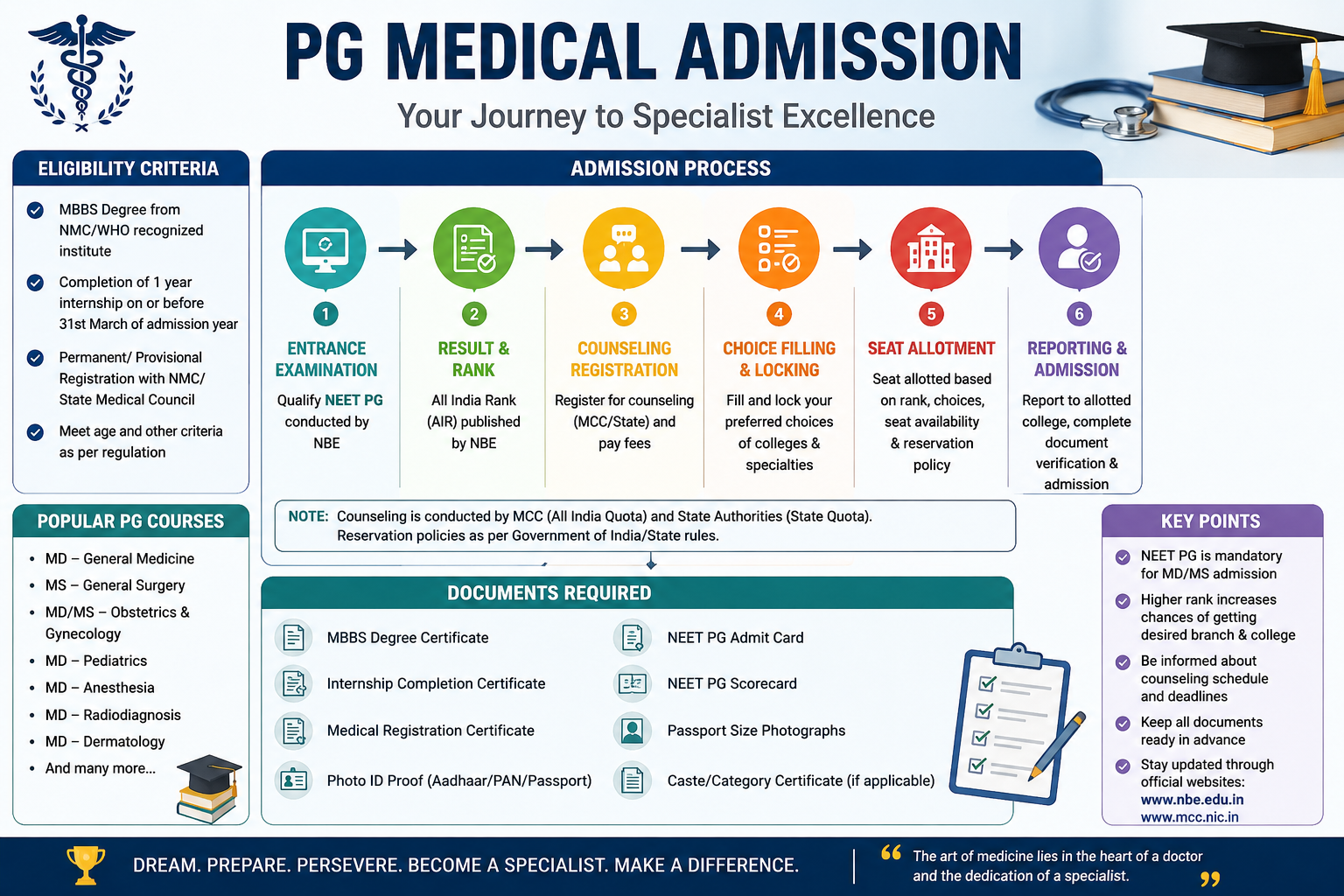
To participate in the allotment of a Management or NRI quota seat, an MBBS graduate must strictly fulfill the statutory requirements laid down by the National Medical Commission (NMC) and the National Board of Examinations in Medical Sciences (NBEMS).
Mandatory Percentile Cutoffs
Failing to qualify the examination disqualifies a candidate from bidding for even the most expensive private seats. You must cross the minimum qualifying percentile threshold:
-
General / EWS: 50th Percentile
-
General – PwD: 45th Percentile
-
SC / ST / OBC (including PwD): 40th Percentile
Mandatory Compliance Timelines
-
Internship Cutoff: Candidates must complete their one-year compulsory rotatory residential internship (CRRI) on or before the officially designated cut-off date (confirmed as September 30 for the current session).
-
Registration Status: A valid permanent or provisional registration certificate issued by the NMC or a State Medical Council is an absolute prerequisite for online portal registration.
2. Decentering the Indian PG Medical Seat Matrix
To map out a successful admission strategy, an applicant must understand the distribution of postgraduate seats across the country. India currently offers approximately 60,000+ postgraduate medical seats, split between Doctor of Medicine (MD), Master of Surgery (MS), and PG Diploma lines, alongside separate DNB streams.
                  [Total PG Medical Seats (~60,000+)]
                                  │
         ┌────────────────────────┴────────────────────────┐
         ▼                                                 ▼
[Government Colleges (~30,000)]                  [Private & Deemed (~30,000)]
         │                                                 │
 ┌───────┴───────┐                                 ┌───────┴───────┐
 ▼               ▼                                 ▼               ▼
[50% All India] [50% State Quota]          [Management Quota] [15% NRI Quota]
The Institutional Landscape
-
Deemed Universities (Centralised Pool): 100% of the seats in Deemed Medical Universities are managed directly by the MCC. Domicile plays no role here; a doctor from any state can apply for any Deemed University seat in India. These are divided into an 85% Management pool and a 15% NRI pool.
-
State Private Medical Colleges: Allotted by individual State DMEs. These states are classified into:
-
Open States: (e.g., Karnataka, Uttar Pradesh, Rajasthan, Haryana) These states allow non-domicile doctors from other parts of India to apply for the management seats within their private colleges.
-
Closed States: (e.g., Maharashtra, Gujarat) These states restrict their private college management allocations strictly to candidates who hold a local domicile or completed their MBBS within that specific state.
-
3. Exhaustive Branch Analysis: MD vs. MS, Fees, and Return on Investment (ROI)
The choice of specialization dictates not only your daily clinical lifestyle but also your financial layout. In the private sector, tuition fees operate on a dynamic supply-and-demand curve dictated by independent practice viability, corporate demand, and emergency workloads.
Tier 1: Premium Clinical Specialties (Highest Investment, Accelerated Practice Growth)
1. MD Radio-Diagnosis (Radiology)
-
Clinical Profile: Non-interventional or interventional imaging diagnostics (MRI, CT, Ultrasound, PET scans). It features an exceptionally high-quality lifestyle with fixed hours and zero chronic ward management.
-
Management Quota Fee Bracket: ₹35 Lakhs to ₹68 Lakhs per annum.
-
NRI Quota Fee Bracket: $80,000 to $130,000 per annum.
-
Earning Potential & ROI: Corporate hospital consultants start at ₹2.5 Lakhs to ₹4.5 Lakhs per month. For those with capital to establish a private diagnostic facility, the long-term ROI is unmatched.
2. MD Dermatology, Venereology & Leprosy (DVL)
-
Clinical Profile: Purely OPD-based with an exploding market cross-over into aesthetic medicine, laser therapies, and trichology. It offers a premium lifestyle with no night shifts or emergency call-outs.
-
Management Quota Fee Bracket: ₹30 Lakhs to ₹60 Lakhs per annum.
-
NRI Quota Fee Bracket: $75,000 to $125,000 per annum.
-
Earning Potential & ROI: Highly lucrative entrepreneurial upside. Private aesthetic clinics in urban areas routinely generate significant cash-flow independent of insurance or corporate networks.
3. MD General Medicine
-
Clinical Profile: The cornerstone of adult healthcare, dealing with complex multisystem disorders, critical care management, and internal diagnostics.
-
Management Quota Fee Bracket: ₹28 Lakhs to ₹48 Lakhs per annum.
-
NRI Quota Fee Bracket: $70,000 to $110,000 per annum.
-
Earning Potential & ROI: Outstanding immediate clinical demand. However, in major metropolitan zones, a plain MD is facing heavy competitive pressure, making a subsequent 3-year DM (Super Specialization) increasingly mandatory for top-tier hospital attachments.
4. MS Obstetrics & Gynaecology (OBG)
-
Clinical Profile: A surgical-medical hybrid branch featuring massive patient volumes, major surgeries (C-sections, hysterectomies), and round-the-clock emergency demands.
-
Management Quota Fee Bracket: ₹25 Lakhs to ₹55 Lakhs per annum.
-
NRI Quota Fee Bracket: $65,000 to $115,000 per annum.
-
Earning Potential & ROI: Exceptionally high corporate and independent nursing home value. An OBG specialist setting up a localized maternity home in a Tier-2 or Tier-3 city recovers their educational capital faster than almost any other specialty.
5. MS Orthopaedics
-
Clinical Profile: Highly mechanical surgical branch focusing on trauma, joint replacements, sports medicine, and spine surgery.
-
Management Quota Fee Bracket: ₹25 Lakhs to ₹45 Lakhs per annum.
-
NRI Quota Fee Bracket: $60,000 to $100,000 per annum.
-
Earning Potential & ROI: Heavy reliance on trauma volume and joint replacements ensures consistent surgical turnarounds. Corporate tie-ups offer strong fixed salaries augmented by surgical incentives.
Tier 2: Core Surgical & Allied Specialties (Steady Practice Models)
6. MS General Surgery
-
Clinical Profile: Deep immersion in basic abdominal, trauma, and soft-tissue operative care.
-
Management Quota Fee Bracket: ₹20 Lakhs to ₹38 Lakhs per annum.
-
NRI Quota Fee Bracket: $55,000 to $90,000 per annum.
-
Strategic ROI Insight: In modern corporate networks, a plain General Surgeon is heavily restricted. Most candidates must view MS General Surgery as a mandatory stepping stone to an MCh degree (Neurosurgery, GI Surgery, Urology, Plastic Surgery). Therefore, smart candidates balance their budget tightly at this stage, preferring open states like Uttar Pradesh where private surgery fees are capped more conservatively, saving capital for the super-specialty phase.
7. MD Paediatrics
-
Clinical Profile: Evergreen, high-volume care covering neonatal intensive care (NICU), pediatric emergencies, and general development.
-
Management Quota Fee Bracket: ₹24 Lakhs to ₹40 Lakhs per annum.
-
NRI Quota Fee Bracket: $60,000 to $95,000 per annum.
-
Earning Potential & ROI: Exceptional independent clinic model. High vaccination turnovers and general pediatric OPD frequencies ensure reliable, scalable independent practices.
8. MS Ophthalmology
-
Clinical Profile: A highly precise, micro-surgical lifestyle branch focused on day-care procedures (Cataract, LASIK, Glaucoma management).
-
Management Quota Fee Bracket: ₹18 Lakhs to ₹35 Lakhs per annum.
-
NRI Quota Fee Bracket: $45,000 to $80,000 per annum.
-
Earning Potential & ROI: While specialized diagnostic and operative hardware requires significant initial capital layout, the minimal post-operative hospital stay overhead ensures outstanding profit margins for independent eye centers.
9. MD Respiratory Medicine (Pulmonology)
-
Clinical Profile: Focuses on sleep medicine, interventional pulmonology, asthma, and heavy ICU management integration.
-
Management Quota Fee Bracket: ₹20 Lakhs to ₹32 Lakhs per annum.
-
Earning Potential & ROI: Post-pandemic, pulmonologists have captured high corporate demand, primarily due to their dual function as critical care intensivists.
10. MD Psychiatry
-
Clinical Profile: Focus on mental health disorders, behavioral science, and neuro-psychiatric conditions. Strictly OPD/consultation-oriented with minimal surgical or physical strain.
-
Management Quota Fee Bracket: ₹15 Lakhs to ₹28 Lakhs per annum.
-
Earning Potential & ROI: Growing societal awareness has accelerated urban OPD volumes. Low initial infrastructure overhead makes it an incredibly low-risk independent practice option.
Tier 3: Support & Para-Clinical Lines (Low-Capital Entries)
11. MD Anaesthesiology
-
Clinical Profile: The operational heart of the theater and critical care units.
-
Management Quota Fee Bracket: ₹14 Lakhs to ₹25 Lakhs per annum.
-
Strategic ROI Insight: Anaesthesiology is one of the most efficient paths to financial independence due to the per-case freelance model. A specialized anaesthesiologist can form alliances with multiple private nursing homes, day-care surgical units, and cosmetic centers, generating high immediate revenue without the overhead of maintaining an independent office or patient ward.
12. MD Pathology
-
Clinical Profile: Cellular, tissue, and molecular diagnostics.
-
Management Quota Fee Bracket: ₹5 Lakhs to ₹18 Lakhs per annum.
-
Strategic ROI Insight: Often overlooked by clinical purists, Pathology represents a powerful entrepreneurial path. To run a fully accredited commercial or hospital laboratory, a signature from an MD Pathologist is legally mandatory. Entering a top-tier Deemed University for Pathology frequently allows for massive fee concessions during later counseling rounds.
Tier 4: Non-Clinical / Pre-Clinical Specialties (Academic & Research Focus)
-
Branches: Anatomy, Physiology, Biochemistry, Pharmacology, Microbiology.
-
Fee Realities: Fees in these departments are heavily deflated, often ranging from completely free or nominal fees (₹1 Lakh to ₹3 Lakhs/year) to attract candidates.
-
ROI Context: These positions do not support private clinical practice. Earning potential is derived from institutional academic salaries, pharmaceutical research roles (Pharmacology), and diagnostic lab supervision (Microbiology/Biochemistry).
4. The Structural Framework of the NRI Quota
The 15% NRI quota represents the most assured way for candidates with modest ranks to secure top-tier clinical seats. However, navigating the strict legal definitions mandated by the Supreme Court of India is highly precise.
The Sponsorship Rules
A candidate can claim an NRI seat via one of two paths:
-
The candidate is an NRI/OCI/PIO cardholder residing abroad.
-
The candidate is an Indian resident but is legitimately sponsored by a first-degree blood relative who holds valid NRI status.
The NMC recognizes only specific, verified blood lineages as acceptable sponsors:
-
Parents (Father or Mother)
-
Real Siblings (Brother or Sister)
-
Paternal or Maternal Uncle/Aunt (Direct blood relatives of the parents)
-
First Cousins (Children of direct uncles/aunts)
-
Spouse
Candidate
 ├── Parents (Father / Mother) ──> Legitimate Sponsors
 ├── Real Siblings             ──> Legitimate Sponsors
 ├── Spouse                    ──> Legitimate Sponsors
 └── Grandparents
      ├── Paternal Uncle / Aunt ──> Legitimate Sponsors
      └── Maternal Uncle / Aunt ──> Legitimate Sponsors
The Nationality Conversion Protocol
Before the launch of Round 1 choice filling, the MCC publishes an online notice opening the NRI Conversion Window. Candidates must submit their physical paperwork digitally within a strict 72-hour window. If your paperwork is rejected due to formatting issues, your profile automatically reverts to the general management pool, blocking you from accessing NRI-allocated seats.
5. Navigating the Digital Counselling Protocol
Securing a direct admission is a multi-phased digital chess game. Missing a timeline or misinterpreting a round’s forfeiture rule can result in immediate disqualification or structural financial losses.
Phase 1: Portal Selection and Multi-Registration
-
Central Pool: Register at
mcc.nic.infor 100% of seats in Deemed Universities across India. -
State Pools: Register individually at state portals (e.g., KEA for Karnataka, UPDGME for Uttar Pradesh) to access private college management seats.
Phase 2: The Security Deposit Lock-In
To prevent frivolous choice filling, portals require heavy upfront, refundable security deposits to unlock the choice preference grids:
-
Deemed Universities (MCC Pool): ₹2,05,000 (₹2 Lakhs refundable deposit + ₹5,000 non-refundable registration fee).
-
Open States Private Colleges: Usually fixed at ₹2,00,000 per state portal.
Phase 3: Choice Filling & Locking Calculations
Candidates enter their preferred permutations of College + Branch. The system runs an automated optimisation algorithm matching rank against preference.
-
Warning: If you lock a college whose fee structure exceeds your actual capital capability, and you are subsequently allotted that seat, you cannot simply decline it without consequence. In Round 2 and beyond, refusing an allotted seat leads to the immediate forfeiture of your ₹2,00,000 security deposit.
Phase 4: Mop-Up and Institutional Stray Vacancy Management
The final rounds are the most dynamic for direct admission seekers. In the Mop-Up Round, seats that were vacated by high-ranking candidates upgrading to government pools suddenly drop into the management matrix, creating unexpected rank drops. The final Stray Vacancy Round is transferred to the physical institutions to fill leftover slots, providing a critical window for final candidate alignments under strict digital supervision.
6. Unmasking the Hidden Structural Traps of Private Medical Education
A common mistake is assuming that the published annual tuition fee represents the entire financial commitment. To safely budget for a 3-year residency, you must account for these institutional mechanisms:
1. The Bank Guarantee Trap
Many private and deemed medical colleges do not allow you to pay your fees on a year-by-year basis without backup security. At the moment of physical admission, they require a legal Bank Guarantee for the remaining tuition fees of Year 2 and Year 3.
-
To obtain a Bank Guarantee, your sponsor must approach a commercial bank and pledge 100% equivalent collateral in the form of fixed deposits, government bonds, or clean property titles.
-
If your annual fee is ₹40 Lakhs, you must have ₹80 Lakhs in liquid assets or real estate locked with the bank to secure the guarantee. If your family cannot arrange this collateral, the college will reject your admission, and your seat will be forfeited.
2. The Discontinuation Penalty Bond
Surgical and clinical departments cannot afford to have a resident leave midway through a course, as it leaves the hospital permanently short-staffed for the remaining duration. Therefore, every private college enforces a Seat Leaving Penalty.
-
In Deemed Universities, if you resign your seat after the final counselling cutoff date, you are legally bound to pay the tuition fees for the entire remaining duration of the 3-year program. If your fee is ₹45 Lakhs, resigning means you must write a check for ₹90 Lakhs to the college before they will physically release your original MBBS degree certificates and registration papers.
7. Comparative Dynamic Analysis: DNB vs. MD/MS Management Quota
For mid-rank doctors, the choice often narrows to a DNB in a top corporate hospital or an MD/MS management seat in a Deemed University. This breakdown highlights the core tradeoffs:
Financial Footprint
-
DNB: Fees are universally capped by the National Board of Examinations (NBE) at a highly affordable ₹1.25 Lakhs per annum.
-
MD/MS Management: Fees range from ₹15 Lakhs to ₹68 Lakhs per annum, requiring a multi-million rupee layout.
Clinical and Surgical Exposure
-
The DNB Reality: Run inside massive multi-speciality corporate hospitals (e.g., Apollo, Fortis, Medanta). You get exposure to ultra-modern, cutting-edge diagnostic technology and global medical protocols. However, because these are premium, paying patients, corporate consultants rarely allow a DNB resident to act as the primary surgeon. Your hands-on surgical cutting time is historically limited.
-
The MD/MS Private Reality: Run inside dedicated medical college hospitals. The patient footfall is massive, often drawn from rural or semi-urban demographics requiring primary, heavy clinical interventions. Private medical college professors prioritize resident hands-on training, meaning your practical surgical cutting volume and clinical independence are frequently far superior to a DNB line.
The Passing Rate Filter
-
MD/MS: Regulated by localized health universities. The passing rates are traditionally very high (95%+), as internal examiners evaluate their own residents.
-
DNB: Controlled by a strict, centralized independent examination board. The final practical exams feature independent external examiners with historically rigorous grading metrics, leading to unpredictable passing rates in core clinical branches.
8. Strategic Summary and Operational Guidance
To secure your specialisation without falling prey to systemic pitfalls, adhere to this tactical checklist:
-
Map Out Collateral Early: If targeting open states like Rajasthan or specific Deemed Universities, ensure your family’s fixed deposits or property titles are clear and ready to generate Bank Guarantees well before the exam results are declared.
-
Verify Stipend Realities: Never assume a private college pays what it claims on paper. Research individual institutional registries to confirm the net monthly cash flow.
-
Audit the Patient Footfall Natively: A beautiful campus means nothing if the clinical wards are empty. Prioritise medical colleges affiliated with long-standing, high-density charitable hospitals where clinical exposure is guaranteed.
To explore real-time tuition fee tracking, historical rank cutoffs for open states, and comprehensive financial simulations for your target specialisations, interact with the data explorer engine below.
Navigating the multi-layered rules of NEET PG counselling requires absolute precision. For personalised, data-backed choice-filling strategies, verified institutional fee audits, and flawless legal conversion support for NRI quota seats across all Indian medical portals, contact our senior admissions advisory team at +91-7406337778 or visit futurembbs.com.