

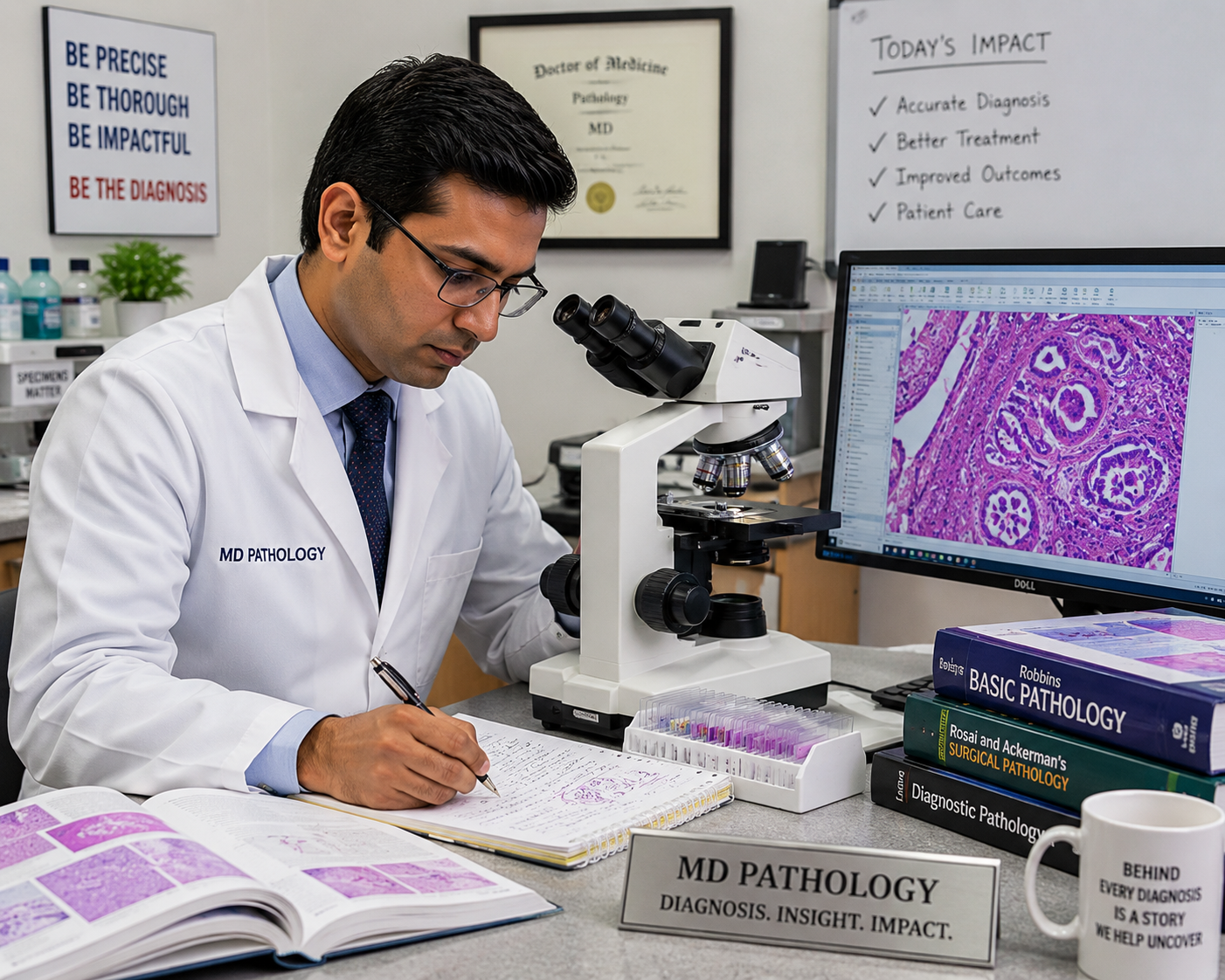
Direct MD Pathology Admission 2026: The Best Guide to Fees, Seat Matrix, and NRI Quota
In the era of evidence-based medicine, no clinical decision, surgical intervention, or targeted oncology treatment occurs without a definitive pathological diagnosis. With the massive post-pandemic boom in corporate diagnostic chains and preventive healthcare, MD Pathology has evolved from a backend academic pursuit into one of the most lucrative and scalable para-clinical branches in India.
Because MD Pathology does not involve direct patient emergencies or gruelling ward duties, it offers an unmatched work-life balance. For doctors who have the financial bandwidth but miss the extremely tight All India Rank (AIR) cutoffs for government institutes, Direct MD Pathology Admission through the Management and NRI quotas provides a highly strategic, legally sanctioned pathway to secure this specialisation.
However, a critical legal reality must be established immediately: There is no backdoor entry into Indian medical residency. Securing a paid seat requires you to qualify for NEET PG and actively participate in the official Medical Counselling Committee (MCC) or State Directorate of Medical Education (DME) counselling rounds. Any agent promising direct admission outside of this centralised digital portal is offering a fraudulent scheme.
Here is your exhaustive, data-backed guide to navigating the 2026 MD Pathology admission matrix, complete with verified fee structures, expected ROI, and strict NRI sponsorship strategies.
1. Why MD Pathology? (ROI and Lifestyle Prioritisation)
When investing in a management quota seat, evaluating the long-term Return on Investment (ROI) is mandatory. Pathology is unique because it is a para-clinical branch. It requires significantly less upfront tuition capital compared to clinical branches like Radiology or General Medicine, yet offers massive entrepreneurial upside.
-
The Diagnostic Boom & NABL Accreditation: The future of Indian healthcare is diagnostics. To run a National Accreditation Board for Testing and Calibration Laboratories (NABL) accredited diagnostic centre, a signature from a qualified MD Pathologist is legally mandatory. You are not just a doctor; you are a legal necessity for the booming diagnostic industry.
-
Pristine Lifestyle: Zero midnight emergencies, no ICU duty, and predictable 9-to-5 working hours. It is the perfect branch for doctors who want a high-income career without the physical burnout associated with surgical branches.
-
Expected Starting Salary (Post-PG): ₹1 Lakh to ₹1.5 Lakhs per month as a consultant in corporate chains (like Metropolis, Dr Lal PathLabs, SRL). However, if you open your own NABL-accredited diagnostic centre, revenue can rapidly scale to ₹3 Lakhs – ₹5 Lakhs+ per month based on B2B hospital tie-ups and B2C patient volume.
-
Prioritisation Insight: If you want the thrill of the operating room or direct patient interaction, Pathology is not for you. But if you have an entrepreneurial mindset, love cellular diagnostics, and want to build a highly scalable, asset-light medical business, Pathology is the ultimate strategic choice.
2. The Seat Matrix: Deemed Universities vs. State Private Colleges
To execute a flawless choice-filling strategy, you need to understand where the paid seats are located and who controls their allocation. India has approximately 3,500 MD Pathology seats, and because it is a para-clinical branch, seat availability in the private sector is generally higher than in core clinical branches.
A. Deemed Universities (100% All India Access)
-
Counselling Authority: Medical Counselling Committee (MCC) via
mcc.nic.in. -
Access: Open to all NEET PG-qualified students across India. State domicile is completely irrelevant.
-
Quota Split: 85% Management Quota / 15% NRI Quota.
-
Strategic Advantage: Deemed Universities have state-of-the-art histopathology, cytopathology, and molecular biology labs. Furthermore, because Pathology is para-clinical, the management fees in Deemed Universities are drastically lower (often 50% to 70% cheaper) than branches like Radiology or Dermatology.
B. State Private Colleges (Domicile Dependent)
-
Counselling Authority: Individual State Directorates of Medical Education (DME).
-
“Open” States: States like Uttar Pradesh, Karnataka, Rajasthan, and Haryana allow non-domicile students from anywhere in India to bid for their management seats. In many open states, private colleges struggle to fill all their Pathology seats, leading to highly affordable fee structures (often between ₹5 Lakhs to ₹12 Lakhs per year).
-
“Closed” States: States like Maharashtra and Gujarat strictly reserve their private college management seats for local domicile students.
3. Deep-Knowledge Fee Matrix: Top Deemed Universities (2025–2026 Data)
Because MD Pathology is not a direct patient-facing clinical branch, it offers some of the best financial value in the private medical sector. Many prestigious institutions heavily subsidise their para-clinical seats to ensure their academic departments remain fully staffed with residents.
Here is the verified fee data for MD Pathology across major Deemed Universities:
| Deemed University | Estimated Management Fee (Per Year) | Estimated NRI Fee (Per Year) |
| Kasturba Medical College (KMC), Manipal | ₹ 19,60,000 | $ 42,200 |
| SBKS Med. Inst. & Research Centre, Vadodara | ₹ 16,50,000 | N/A (Converted to Mgmt) |
| Hamdard Institute of Medical Sciences, New Delhi | ₹ 15,00,000 | N/A |
| Dr D.Y. Patil Medical College, Pune | ₹ 15,00,000 – ₹ 20,00,000 | $ 30,000 – $ 40,000 |
| JSS Medical College, Mysore | ₹ 12,00,000 – ₹ 15,00,000 | $ 25,000 |
| Meenakshi Medical College, Chennai | ₹ 10,00,000 | $ 20,000 |
| Average State Private Colleges (UP/Karnataka) | ₹ 5,00,000 to ₹ 10,00,000 | N/A |
Note: Tuition fees are strictly charged for 3 years. Notice how institutions like KMC Manipal charge nearly ₹34 Lakhs/year for Radiology, but only ₹19.6 Lakhs/year for Pathology. In many mid-tier private colleges, you can secure an MD Pathology seat for as low as ₹6 Lakhs per year.
4. Securing MD Pathology via the NRI Quota
Because MD Pathology fees are already relatively low, the NRI quota for this branch operates differently than it does for Tier-1 clinical branches. In many Deemed Universities, NRI seats for Pathology go vacant and are subsequently converted into standard Management seats during the Mop-Up round.
However, if you are an NRI candidate and want absolute certainty of securing a seat in a top-tier institute like KMC Manipal without worrying about cutoffs, the NRI quota remains highly viable.
Strict Sponsorship Rules
The National Medical Commission (NMC) rigidly controls who can sponsor an NRI seat to prevent domestic financial fraud. You cannot be sponsored by a family friend. Acceptable sponsors strictly include a First-Degree Blood Relative:
-
Parents (Father or Mother)
-
Real Siblings (Brother or Sister)
-
Paternal or Maternal Uncle/Aunt (Blood relations only)
-
First Cousins
-
Spouse
Mandatory Documentation for NRI Conversion
Before choice filling begins on the MCC portal, there is a narrow window (usually 3-4 days) to email a comprehensive PDF and convert your nationality status to NRI. Missing this window disqualifies you entirely.
-
Notarised Sponsorship Affidavit: A sworn legal declaration from the sponsor taking full financial responsibility.
-
Embassy Certificate: Issued by the Indian Consulate in the sponsor’s country of residence.
-
Family Tree Document: A legal affidavit mapping the exact blood lineage between you and the sponsor.
-
Financial Proof: The tuition fees must be wired directly from the sponsor’s NRE/NRO bank account in USD or equivalent converted INR.
5. The Step-by-Step Direct Admission Counselling Process
Do not let agents hijack your counselling portal. The mechanism is entirely digital, transparent, and strictly time-bound.
6. Expert Insights: The Hidden Costs and Negotiation Tactics
Evaluating the yearly tuition fee is just the starting point. Because Pathology sits in a unique demand bracket, your strategy should account for the following:
| Strategic Factor | Impact on MD Pathology Candidates |
| Stipend Parity | Unlike clinical branches, where private colleges heavily reduce stipends, para-clinical residents often receive stipends closely matching government norms (₹40,000 – ₹70,000/month) because they form the backbone of the hospital’s central diagnostic lab. |
| Hostel & Mess Fees | Residency is a 24/7 job, even for pathology (handling emergency frozen sections). Living on campus is strictly mandatory. Institutional hostel fees range from ₹1.5 Lakhs to ₹3.5 Lakhs annually. |
| The Bank Guarantee Trap | Many private colleges demand a Bank Guarantee for the remaining two years of fees at the time of admission. You must pledge liquid assets or property equivalent to the remaining fees to the bank. |
| Institutional Negotiation | Insider Secret: In lesser-known private medical colleges in states like UP, Rajasthan, or Haryana, management seats for MD Pathology often go vacant. If you wait until the Stray Vacancy round, institutions are frequently willing to negotiate the tuition fee downward legally to ensure the seat is filled. |
Navigating the NEET PG 2026 admission matrix for MD Pathology requires strategic precision. A single error in evaluating a state’s open status, misformatting an NRI embassy certificate, or locking a choice without understanding the bank guarantee requirements can derail your career.
Ensure your entire counselling flow—from Round 1 choice filling to Mop-Up round strategy—is mathematically optimised for your exact budget, rank, and preferred academic exposure.