


Direct MD General Medicine Admission: Exact Fees & Seat Matrix in Top Deemed Universities
MD General Medicine is the undisputed intellectual core of clinical practice. As the absolute foundation for diagnosing complex adult diseases and the mandatory stepping stone for highly lucrative super-specializations (DM in Cardiology, Neurology, Gastroenterology, etc.), it remains one of the most fiercely contested postgraduate medical seats in India.
With roughly 6,300+ MD General Medicine seats available nationwide, the competition is brutal. If your All India Rank (AIR) in NEET PG falls short of the stringent government cutoffs, Direct MD General Medicine Admission through the Management and NRI quotas provides a highly strategic, legally sanctioned pathway to secure this premium branch.
However, the medical admission landscape is rife with misinformation. Let us establish the undeniable legal reality immediately: There is no “backdoor” entry into any PG medical program in India. Direct admission strictly refers to securing a seat via the Management or NRI quota in Deemed Universities and Private Medical Colleges, strictly through centralised digital counselling.
Here is your exhaustive, data-backed guide to navigating the 2026 MD General Medicine admission matrix, complete with precise fee brackets, ROI prioritisation, and NRI sponsorship strategies.
1. Why MD General Medicine? (ROI and Career Prioritisation)
Before committing millions of rupees to a management seat, you must evaluate the long-term Return on Investment (ROI). MD General Medicine requires immense stamina—gruelling hours, high ICU/IPD exposure, and complex diagnostics—but the financial and professional rewards are astronomical.
-
The Super-Speciality Gateway: A standard MS General Surgeon faces heavy competition without an MCh, but an MD General Medicine graduate can establish a highly successful independent practice immediately. Alternatively, it unlocks the path to DM degrees (Endocrinology, Nephrology), which command the highest corporate salaries in the country.
-
Expected Starting Salary (Post-PG): ₹1.5 Lakhs to ₹3 Lakhs per month (Corporate setups or Tier-2 city private practice).
-
Prioritization Insight: If your goal is purely lifestyle-driven (9-to-5 hours, zero emergencies), you should pivot to Dermatology or Radiology. However, if you thrive on high patient volume, complex problem-solving, and immense clinical respect, MD General Medicine is unparalleled.
2. The Seat Matrix: Deemed Universities vs. State Private Colleges
To execute a successful admission strategy, you must understand where the seats are located and who controls them. Out of the ~6,300 MD General Medicine seats in India, the paid seats are divided into two distinct categories:
A. Deemed Universities (100% All India Access)
-
Counseling Authority: Medical Counselling Committee (MCC) via
mcc.nic.in. -
Access: Open to all NEET PG qualified students across India. Domicile is entirely irrelevant.
-
Quota Split: 85% Management Quota / 15% NRI Quota.
-
Strategic Advantage: Highly transparent process, excellent infrastructure, but premium pricing.
B. State Private Colleges (Domicile Dependent)
-
Counseling Authority: Individual State Directorates of Medical Education (DME).
-
“Open” States (High Opportunity): States like Uttar Pradesh, Karnataka, Rajasthan, and Haryana allow non-domicile students to bid for their management seats. For instance, Uttar Pradesh is highly sought after because its private college fees are strictly capped by the government (often between ₹14 Lakhs to ₹25 Lakhs per year).
-
“Closed” States: States like Maharashtra, Gujarat, and Madhya Pradesh reserve their private college management seats strictly for local domicile students.
3. Deep-Knowledge Fee Matrix: Top Deemed Universities (2025–2026 Data)
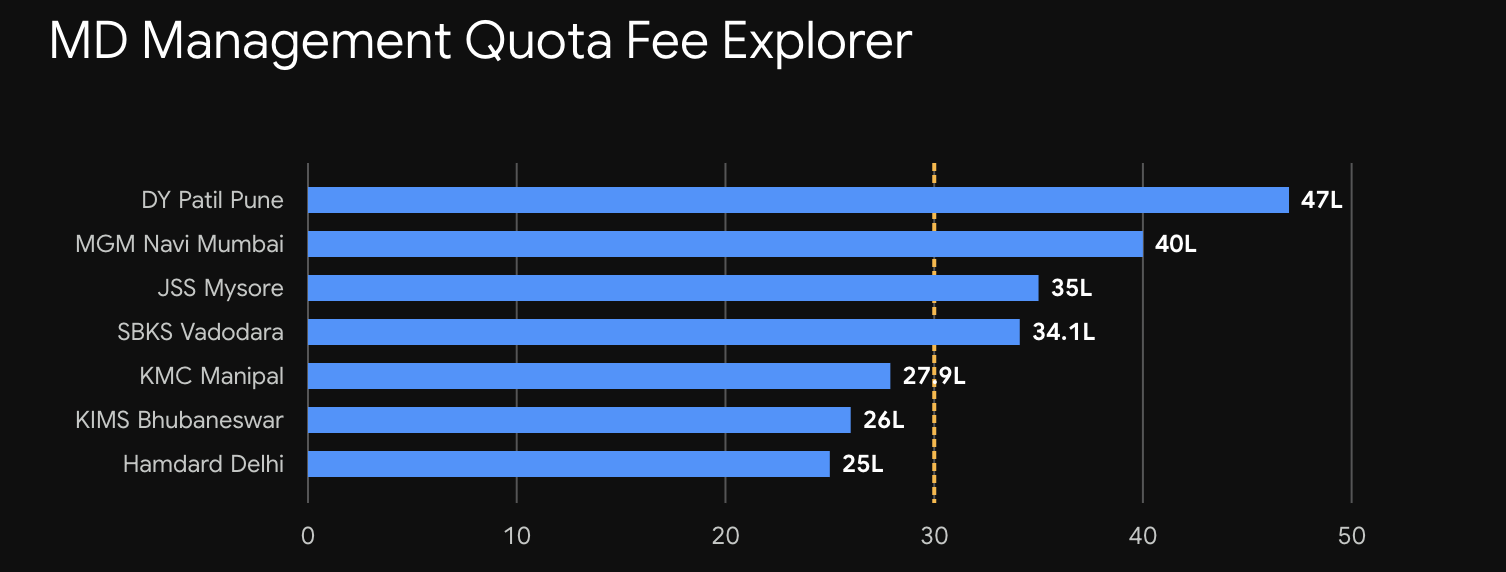
The financial disparity between institutions for the exact same degree is massive. Your choice-filling strategy must align perfectly with your budget, as locking a seat you cannot afford leads to forfeiture of your ₹2 Lakh security deposit.
Here is the verified fee data for MD General Medicine across India’s top Deemed Universities:
| Deemed University | Estimated Management Fee (Per Year) | Estimated NRI Fee (Per Year) |
| Dr. D.Y. Patil Medical College, Pune | ₹ 47,00,000 | $ 1,20,000 |
| MGM Medical College, Navi Mumbai / Aurangabad | ₹ 40,00,000 | $ 1,00,000 |
| JSS Medical College, Mysore | ₹ 35,00,000 | $ 80,000 |
| SBKS Med. Inst. & Research Centre, Vadodara | ₹ 34,10,000 | $ 83,100 |
| Kasturba Medical College (KMC), Manipal | ₹ 27,92,000 | $ 59,600 |
| Kalinga Institute of Medical Sciences, Bhubaneswar | ₹ 26,00,000 | $ 60,000 |
| Hamdard Institute of Medical Sciences, New Delhi | ₹ 25,00,000 | $ 70,000 |
Note: Under the National Medical Commission (NMC) rules, tuition fees are strictly charged for 3 years for PG courses. Always multiply the annual fee by 3 to calculate your base capital requirement.
4. Securing MD General Medicine via the NRI Quota
If your NEET PG rank is critically low (just touching the 50th percentile for the General category or 40th for OBC/SC/ST) but you have strong international financial backing, the NRI quota bypasses the intense merit-based management cutoffs. 15% of all Deemed University seats are reserved for this category.
Strict Sponsorship Rules
You cannot be sponsored by a family friend. The sponsor must be a First-Degree Blood Relative. Acceptable sponsors strictly include:
-
Parents (Father or Mother)
-
Real Siblings (Brother or Sister)
-
Paternal or Maternal Uncle/Aunt (Blood relations only)
-
First Cousins
-
Spouse
Mandatory Documentation for NRI Conversion
Before choice filling begins on the MCC portal, you must email a comprehensive PDF to convert your nationality status to NRI. Missing this narrow 3-day window disqualifies you from NRI bidding.
-
Notarised Sponsorship Affidavit: A legal declaration from the sponsor taking full financial responsibility.
-
Embassy Certificate: Issued by the Indian Consulate in the sponsor’s country of residence.
-
Family Tree Document: A sworn legal affidavit mapping the exact blood lineage between you and the sponsor.
-
Financial Proof: The massive tuition fees (often exceeding $250,000 total) must be wired directly from the sponsor’s NRE/NRO bank account in USD or equivalent converted INR.
5. The Step-by-Step Direct Admission Counselling Process
Do not let brokers hijack your counselling. The process is entirely digital, transparent, and unforgiving of errors.
6. Expert Insights: The Hidden Costs of MD Medicine Residency
Evaluating the yearly tuition fee is only the beginning. Before finalising your choices, you must factor in the hidden, structural costs of a private residency:
| Financial Factor | Impact on MD Candidates |
| Hostel & Mess Fees | Residency is a 24/7 job. Living on campus is strictly mandatory. Institutional hostel fees range from ₹1.5 Lakhs to ₹3.5 Lakhs annually. |
| Stipend Deductions | While government residents earn up to ₹1.2 Lakhs/month, Deemed and Private universities often pay heavily reduced stipends (₹30,000 – ₹50,000/month) or practically zero for NRI candidates. Factor this loss of income into your ROI calculations. |
| The Bank Guarantee Trap | Many private colleges demand a Bank Guarantee for the remaining two years of fees at the time of admission. You must pledge liquid assets or property equivalent to ₹60 Lakhs+ to the bank to secure this guarantee. |
| Seat Leaving Penalties | Resigning from an MD Medicine seat midway (to upgrade or change fields) triggers a penalty bond. In Deemed universities, this legally obligates you to pay the entire 3-year course fee before they release your original MBBS certificates. |
Navigating the NEET PG 2026 admission matrix for MD General Medicine requires absolute clinical precision. A single error in evaluating a state’s open status, misformatting an NRI embassy certificate, or locking a choice without understanding the bank guarantee requirements can derail your career and cost you millions.
Ensure your entire counselling flow—from Round 1 choice filling to Mop-Up round strategy—is mathematically optimised for your exact budget, rank, and preferred clinical exposure.
Ready to secure your MD General Medicine seat? For highly strategic, data-backed admission consultancy, verified fee matrices, and precise NRI documentation support, reach out directly at +91-7406337778 or visit futurembbs.com. We ensure your transition into a specialised physician is executed transparently and legally.