

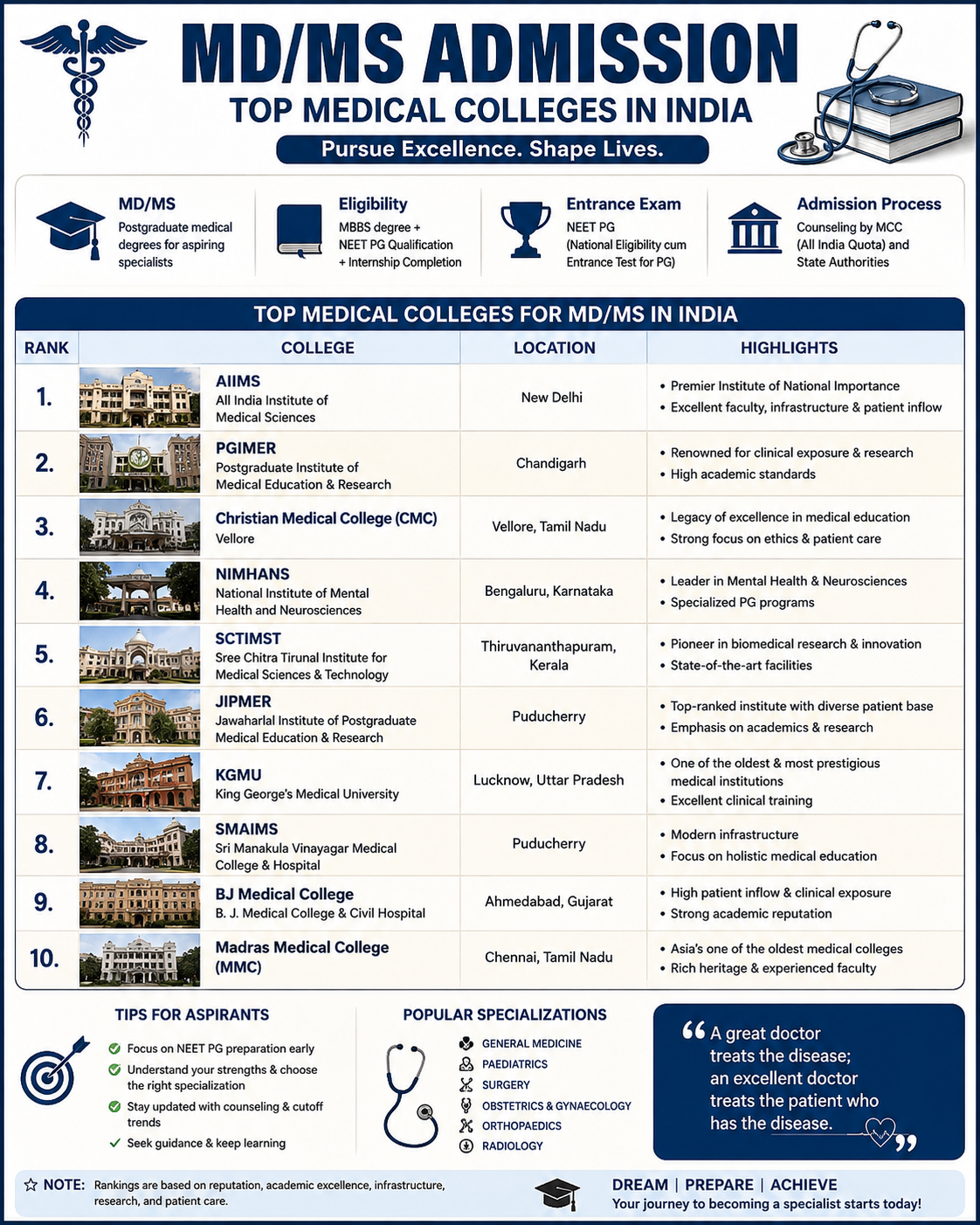
Direct MD MS Admission in Top Private Medical Colleges: 2026 Fees & Seat Matrices
Securing a postgraduate clinical seat in branches like Radiology, Dermatology, or General Medicine is one of the most intensely competitive phases of a medical career. When state merit and All India Quota (AIQ) seats slip just out of reach due to soaring cut-offs, management and NRI quotas in premier deemed medical universities offer a vital, legitimate pathway to your dream speciality.
However, a critical reality check is necessary: “Direct admission” does not mean bypassing exams. To be eligible for management or NRI quota seats, you must successfully qualify for the NEET-PG examination. All seat allotments are strictly conducted through the Medical Counselling Committee (MCC). There are no “backdoor” admissions.
A strategic approach requires an exact understanding of the 2025 fee structures, hidden costs, and shifting seat matrices across India’s elite institutions. Here is the data-driven guide to making an informed decision for your MD/MS admission.
Understanding Management vs. NRI Quotas
Before diving into the college specifics, it is essential to understand the two primary avenues for admission in deemed universities:
-
Management Quota: These seats are open to any NEET-PG qualified Indian student. The fees are significantly higher than government seats but follow a transparent, institution-defined structure.
-
NRI Quota (Non-Resident Indian): Typically comprising 15% of the total seats in deemed universities, this quota is reserved for NRIs, PIOs, OCIs, or students sponsored by first-degree NRI blood relatives. The fee is charged in US Dollars (USD) and is generally 30% to 50% higher than the management quota. If NRI seats remain vacant after the initial counselling rounds, they are often converted to management seats during the stray vacancy rounds.
Top 10 Deemed Medical Colleges for MD/MS in India
Below is a detailed breakdown of the premier deemed medical universities in India, equipped with the latest 2025 benchmark tuition fees and seat matrices.
1. Kasturba Medical College (KMC), Manipal
KMC Manipal consistently ranks among the top 10 medical colleges in India, offering unparalleled clinical exposure.
-
Seat Matrix: Offers highly sought-after clinical PG seats with a sizable allocation for both management and NRI quotas.
-
Exact Fees (Per Year): * MD Radiology: ₹50,00,000 (Management)
-
MD Dermatology: ₹55,00,000 (Management)
-
MD General Medicine: ₹40,00,000 (Management)
-
MS General Surgery: ₹30,00,000 (Management)
-
-
NRI Fees: Clinical branches range between $70,000 to $90,000 per year.
2. JSS Medical College, Mysore
Known for its massive patient footfall and cutting-edge infrastructure, JSS Mysore is a top choice for surgical and clinical branches.
-
Exact Fees (Per Year):
-
MD Radio-Diagnosis & Dermatology: ₹33,50,150 (Management) | $95,000 (NRI)
-
MD TB & Respiratory Medicine: ₹26,50,150 (Management)
-
MS Orthopaedics & General Surgery: ₹23,12,500 to ₹33,50,150 depending on exact round mapping.
-
MS Ophthalmology & ENT: ₹21,50,150 (Management)
-
Non-Clinical (Anatomy/Physiology): Highly subsidised at just ₹10,000/year.
-
3. Kasturba Medical College (KMC), Mangalore
Operating under the same elite MAHE banner as its Manipal counterpart, KMC Mangalore offers slightly more accessible fee structures for certain branches.
-
Exact Fees (Per Year):
-
MD Radiology: ₹48,00,000 (Management)
-
MD Dermatology: ₹52,00,000 (Management)
-
MD General Medicine: ₹35,00,000 (Management)
-
MS General Surgery: ₹28,00,000 (Management)
-
4. Dr D.Y. Patil Medical College, Hospital & Research Centre, Pune
With one of the largest intake capacities in Maharashtra, D.Y. Patil Pune is known for its advanced robotics and critical care units.
-
Fee Range: Clinical management quota fees range steeply from ₹30,00,000 to ₹65,00,000 per year, making it one of the premium-priced options. NRI fees range from $1,10,000 to $1,30,000 per year for top clinical branches.
5. Sri Ramachandra Medical College (SRMC), Chennai
A powerhouse in Southern India, SRMC offers deep academic rigor.
-
Fee Range: Management quota fees for clinical subjects average around ₹32,00,000 per year.
-
NRI Fees: Total package for the 3-year clinical course usually hovers around $2,25,000.
6. Amrita Institute of Medical Sciences (AIMS), Kochi
AIMS is renowned for its super-specialty hospitals and rigorous academic discipline.
-
Fee Range: Expect clinical management fees to fall between ₹25,00,000 and ₹35,00,000 annually.
7. K.S. Hegde Medical Academy (KSHEMA), Mangaluru
A highly reputed mid-tier deemed university offering excellent value for its clinical programs.
-
Fee Range: The highest clinical branches (Radiology/Dermatology) touch ₹31,30,000 per year, while others scale down to ₹21,30,000.
8. Hamdard Institute of Medical Sciences (HIMSR), New Delhi
Located in the capital, HIMSR is highly competitive due to its strategic location and patient density.
-
Fee Range: Management quota fees range from ₹25,00,000 to ₹40,00,000 per year. NRI fees range from $60,000 to $85,000 annually.
9. Jawaharlal Nehru Medical College (JNMC), Belagavi (KLE)
A massive campus with a high volume of rural and urban clinical cases.
-
Fee Range: Management fees vary widely by branch, ranging from ₹27,50,000 to ₹33,82,000 annually for clinical specialities.
10. Bharati Vidyapeeth Deemed University Medical College, Pune
A staple choice for students seeking admission in Maharashtra, offering a balanced mix of academics and clinical volume.
-
Fee Range: Fees span from ₹25,00,000 to ₹42,44,625 per year for management clinical seats. NRI packages range from $30,000 to $1,38,600 per year, depending on the speciality.
Navigating the MCC Seat Matrix & Admission Strategy
Understanding the fee is only half the battle. The MCC counseling process requires a calculated choice-filling strategy.
-
Assess Your Budget Holistically: Deemed university fees mentioned above are strictly tuition fees. Always account for annual hostel charges (which can range from ₹1.5 Lakhs to ₹3 Lakhs for AC rooms), mess fees, and one-time refundable security deposits (often around ₹2,00,000).
-
Round 1 vs. Mop-Up Round Dynamics: Historically, premier clinical branches at top institutes like KMC Manipal and JSS Mysore close in the early rounds. However, high-fee NRI seats that remain unfilled are occasionally converted to management seats in the Stray Vacancy round. While this drops the seat into the management pool, banking entirely on the stray round is highly volatile and risky.
-
Evaluate Stipend and Bond Regulations: Unlike government colleges where bonds are strict, most deemed universities do not impose rural service bonds. However, verify the monthly stipend offered; institutes like JSS Mysore provide a stipend of approximately ₹55,000/month, which helps offset some living expenses.
Connect with the Experts
Securing a clinical MD/MS seat through the management or NRI quota involves high stakes, massive financial planning, and an airtight counselling strategy. An error in preference mapping during MCC counselling can land you in a higher fee bracket than you anticipated, or worse, leave you unallotted.
At FutureMBBS.com, our seasoned admissions consulting team specialises in precise, data-driven MCC counselling. We analyse your exact NEET-PG rank against live seat matrices and hidden fee variables to ensure you secure the highest possible clinical branch at the best possible institution.
Ready to secure your speciality? Don’t leave your PG admission to chance. Explore our portal or contact our advisory team today to map out your perfect medical future.
The Hidden Math: Calculating Your True 3-Year Package
When planning for direct admission through management or NRI quotas, looking solely at the annual tuition fee is a rookie mistake. Medical colleges have distinct financial ecosystems, and your Return on Investment (ROI) is heavily dictated by hidden costs and stipend offsets.
To calculate your True 3-Year Package, you must account for the following variables:
-
The Stipend Offset: Not all deemed universities offer stipends to management or NRI quota students. For example, JSS Mysore is known for providing a robust stipend of approximately ₹55,000 per month (totaling nearly ₹19.8 Lakhs over three years), which significantly softens the blow of the tuition. Conversely, institutions like D.Y. Patil Pune may charge premium tuition while offering minimal to no stipend for specific quota seats.
-
Annual Fee Increments: While institutions like KMC Manipal have relatively static fee structures, some universities reserve the right to increase tuition by 5% to 10% annually. Always check if the fee is locked for the entire 3-year duration.
-
Hostel, Mess, and Security Deposits: Premier deemed universities mandate hostel stays. AC accommodations can run from ₹1.5 Lakhs to ₹3 Lakhs annually. Furthermore, a one-time refundable security deposit of ₹2,00,000 is standard across the board, payable during admission.
The Penalty Trap: MCC 2025/2026 Forfeiture Rules
We know that navigating NEET PG counseling can feel like walking through a minefield. The most critical misconception is that you can block a deemed university seat as a “backup” without consequences. The MCC has implemented ruthless penalty clauses for the 2025/2026 sessions to prevent seat blocking:
-
Round 1 (Free Exit): You can accept a seat and leave it without financial penalty. Your ₹2,00,000 MCC security deposit will be refunded or carried forward.
-
Round 2 (The Trap Door): If you are allotted a Deemed University seat in Round 2 and choose to exit or fail to report, you will forfeit your ₹2,00,000 security deposit. Furthermore, joining a Round 2 seat and later attempting to resign violates strict MCC timelines and will lock you out of further upgrades.
-
Stray Vacancy Round (The Danger Zone): If you are allotted a seat in the Stray Vacancy round and fail to join, not only do you forfeit your security deposit, but you are completely debarred from the NEET PG examination for the subsequent year. ## NRI Sponsorship: Why 80% of Applications Fail
For students who narrowly miss the management quota cut-offs, NRI sponsorship is the ultimate lifeline. However, the MCC scrutinises these applications heavily. In the 2025/2026 counselling cycle, the MCC enforces a strict sequential priority system, and simple paperwork errors result in immediate disqualification.
The Priority System:
-
Priority 1: Direct NRI Candidates or Children of NRIs.
-
Priority 2: First-degree relatives (siblings, spouse) or Second-degree relatives (grandparents, maternal/paternal uncles, aunts, or first cousins) acting as sponsors.
The Document Checklist (Where Most Fail):
To successfully convert your category from Indian to NRI before the MCC deadline, your Priority 2 sponsor must provide flawless documentation. The most common reasons for rejection include:
-
Missing Embassy Certificate: You must have a valid certificate from the Indian Embassy/Consulate in the sponsor’s country issued within the last 6 months.
-
Flawed Relationship Affidavit: A notarised family tree issued by a competent Revenue Authority proving the exact bloodline between you and the sponsor is mandatory.
-
Financial Proof Discrepancies: The sponsor must provide an NRE Bank Account passbook and a notarised affidavit taking full legal responsibility for the entire 3-year tuition.
If any of these documents are missing or fail verification during physical reporting, the medical college will cancel the allotted seat on the spot.
2026 True Cost & Strategy Planner
To master the admission process, you need to align your budget with historical counselling realities. Use this interactive planner to select your target speciality and see the projected 3-year true cost (factoring in stipends) alongside the MCC counselling risk level for top deemed universities.
Author Bio: FutureMBBS
This guide was curated by Parijat Preetam, Lead Educational Consultant at FutureMBBS.com. With extensive expertise in medical, engineering, law, and management admissions across India, Parijat specialises in securing high-value MBBs, BDS, MD, and MS seats through meticulous state and MCC counselling strategies. For personalised, data-driven admission consulting, contact the FutureMBBS team today.